
Installing Lithium Batteries for Domestic Power on Leisure Craft
Guidance on installation

The Joint Cruising Association and Inland Waterways Association Working Group on Lithium Battery Safety

Considerations for owners and users when fitting lithium batteries for domestic power purposes.
- Scope
The original aim of the joint working group was to provide guidance for self-installation of a lithium iron phosphate (LiFePO4 or LFP) system for domestic or “house” electrical loads.
Through the course of our analysis, we realised that the general understanding of the complexities of LFP installation is not yet mature enough for the establishment of clear and definitive guidelines at professional trade level. Consequently, this has made it impossible to give authoritative guidance to the amateur installer without our working group attempting to replicate the ongoing work by the industry and the standards bodies.
This document therefore aims to sit in the middle ground to provide information on the make-up and complexities of an LFP system; describe current good practice and to provide a usable check-list to inform users of what questions to ask a professional installer when specifying, installing, commissioning and maintaining an LFP system.
This document could also be used by competent individuals as a starting point for self-installation, but the IWA and the CA would not recommend self-installation for the vast majority of members. - Introduction
Lithium battery installation is not just a battery replacement. Lithium systems can provide greater usable capacity, faster charging, lower weight and longer life, but they require the battery, battery-management-system (BMS), charging sources, alternator arrangements, wiring and protection to work together as one system. For a system to remain safe, systems must also be competently monitored, and should things go wrong, evacuation rather than fire-fighting must be the principal response. - Hardware and physical installation
Before buying equipment, owners must decide what the domestic battery bank should actually support. They should recalculate the boat’s energy needs rather than simply matching the old lead-acid amp-hour rating. Consider optimum system voltage (e.g. 12V, 24V, 48V), daily consumption, peak inverter loads, charging opportunities, reserve capacity, and whether future loads such as electric cooking, additional refrigeration or larger inverters are likely.
- Battery choice, chemistry and capacity
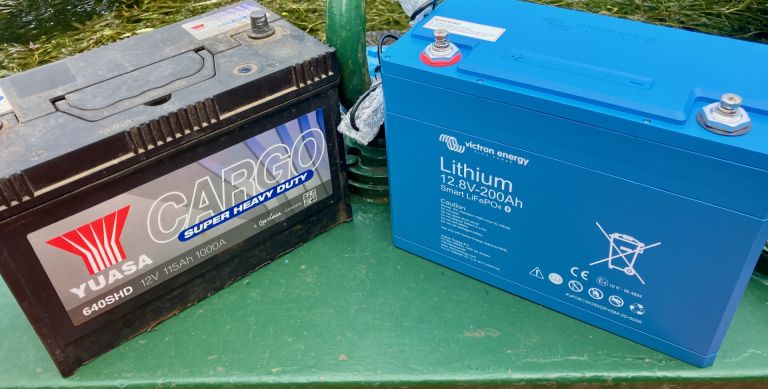
LFP (LiFePO4) is commonly chosen for leisure craft use because it offers good cycle life and thermal stability compared with other lithium-ion chemistries. At present, it is the only lithium battery chemistry the group would recommend for installation. However, it is still a lithium-ion battery and should be selected, installed and managed as part of a lithium-ion system. Suppliers or installers should be asked to confirm the chemistry, capacity, C rating (charging and discharging rate), safe operating limits, permitted charge and discharge currents, temperature limits, installation orientation and whether series or parallel connection is allowed.
Owners should avoid relying on vague claims such as “drop-in”, “marine grade” or “suitable for boats” without evidence. The battery should be supported by manufacturer safety information and should be suitable for the boat’s environment, including vibration, water exposure, corrosion risk, temperature range and the way the battery will be charged and discharged. - Location, securing and environment
Batteries should be installed in a dry and secure location which is vented to the outside and isolated from the boat’s living spaces. Systems must be protected from shock, vibration, water, corrosion, mechanical damage, high and low temperatures and sources of external heat. The location should allow inspection, servicing, cable access and safe isolation, ideally without dismantling unrelated equipment.
Manufacturer’s instructions must be followed for mounting orientation, clearances, ingress protection, containment, ventilation or cell venting and temperature limits. Consideration should also be given to whether the reduction in battery weight compared with the previous battery system could affect trim or weight distribution. - Charging sources and electrical integration
Every charging source must be checked for compatibility with the selected lithium battery and BMS. This includes the engine alternator, shore-power charger, solar controller, wind or hydro generator, inverter-charger and any DC-DC chargers. Existing charging equipment may be unsuitable unless it can be correctly configured and controlled, in which case it must be replaced.
Alternators need particular attention because lithium batteries will accept high charging currents for long periods. The installation may need alternator temperature monitoring, external regulation, current limiting, DC-DC charging or load-dump protection to prevent alternator overheating or damage if the BMS disconnects the battery bank while charging. - Wiring, fusing, isolation and components
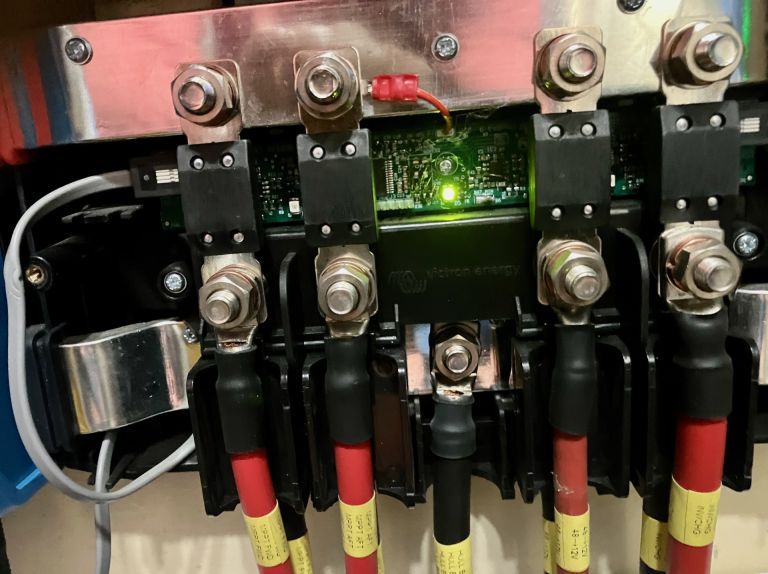
Lithium batteries can deliver very high fault currents. Cables, busbars, battery switches, fuses and circuit breakers must be correctly rated for continuous current and fault current. Crimps must be correctly made and terminals tightened to the correct torque setting. Overcurrent protection should be located as close as practicable to the battery or busbar and should have sufficient ampere interrupt capacity for the battery bank. Where a non LFP starter battery is retained, it should remain electrically separated from the lithium domestic bank except through properly specified charging equipment. It should not be assumed that existing split-charge diodes, voltage-sensitive relays, manual paralleling switches or “1-2-both” switches are suitable. Good-quality components from established manufacturers should be used and cheap or low-quality switches, fuses, breakers or cable terminals avoided.
The installer should provide a documented design showing the battery bank, BMS, fuses, breakers, isolators, busbars, cable sizes, chargers, alternator protection, inverter connections, monitoring and emergency shutdown arrangements. They should also explain how the system behaves in normal use and how and when the BMS disconnects the battery, and what happens if it does.
© Jonathan Mosse
- Battery choice, chemistry and capacity
- Protection and safety
Lithium battery systems rely on active monitoring and automatic protection systems along with competent user intervention to maintain safe operation. Automatic systems should prevent foreseeable faults, warn the user when action is needed, and procedures should make it clear what to do if the system shuts down, gives an alarm, vents gas, overheats or there is a fire. - Battery Management System and safe operating limits
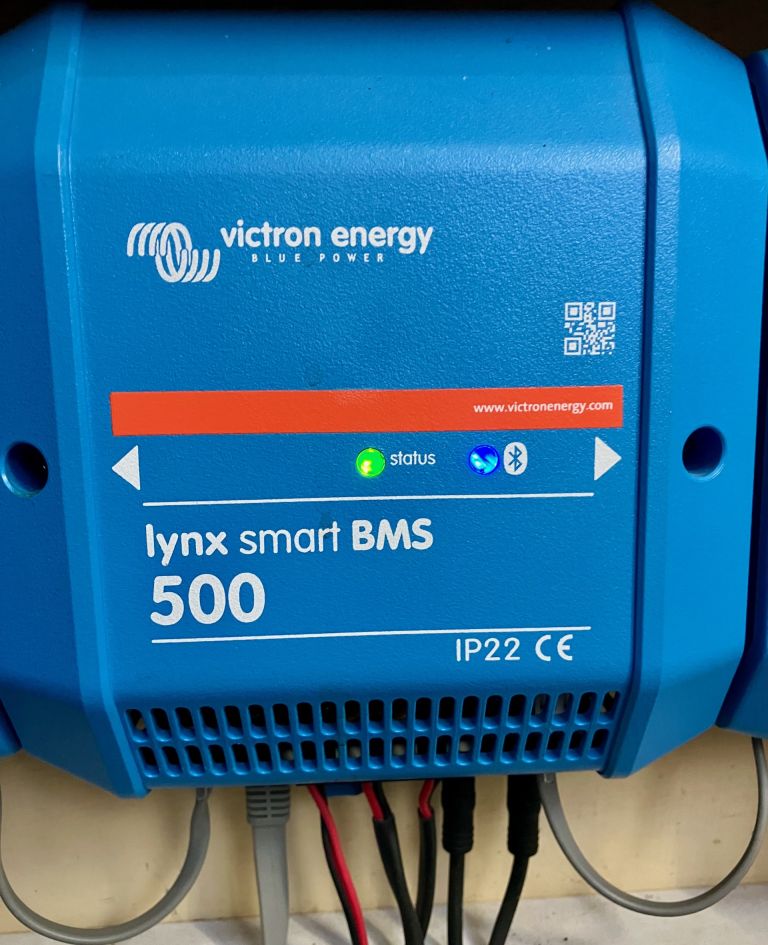
The BMS is a critical safety component. It should keep the battery within the manufacturer’s safe operating limits for voltage, current, temperature, charge, discharge and storage. It should protect against overcharge, over-discharge, high temperature, low temperature, overcurrent and cell imbalance. It should also coordinate with the boat’s charging sources and monitoring system.
Owners should understand what the BMS does before it disconnects the battery. A good system should provide clear warnings where possible, stop or reduce charging sources, protect non-essential loads and avoid the sudden loss of critical systems. If navigation lights, engine starting, communications or other safety-related equipment could be affected by a BMS shutdown, alternative or independent power sources should be considered to maintain these systems. - Monitoring, alarms and owner information
Owners and users should be able to note and understand the status of the battery system. Information should include state-of-charge, voltage, current, battery temperature, charger status, BMS alarms, fault codes and whether loads or charging sources have been isolated. Traditional lead-acid battery monitors may not give reliable lithium state-of-charge information unless correctly specified and configured.
The owner / user should receive an easy-to-understand operating guide covering normal use, charging, storage considerations, alarm response, shutdown parameters, reset procedures, emergency isolation and when to call on skilled advice. If multiple battery banks are installed, the system should coordinate between BMS units and warn the user if capacity or protection has been reduced.
The system should have at least two different and controlled levels of access (e.g. for manufacturer/installer and end user), for both safety-critical settings (e.g. charging voltage) and firmware/software updates. This is to prevent unqualified users from compromising system safety by changing safety-critical settings and prevent the installation of third-party software that could compromise inbuilt safeguards. - Fire, gas release and emergency planning
A well-designed LFP domestic installation will operate safely, but any lithium-ion battery failure can develop quickly and may release heat, smoke, toxic and or flammable gases or vapour. Any fans used within the ventilation system must be non-sparking. Although standard smoke alarms may not give early warning of battery off-gassing, certified and working smoke and carbon monoxide alarms should still be fitted, tested regularly and audible throughout the boat.
Fire protection should follow the battery manufacturer’s recommendations and the system risk assessment. There is no single generic extinguisher or compartment design that is suitable for every lithium battery installation. Consider fire detection, off-gas detection, cell venting, general ventilation, containment, escape routes and the consequences of using water or other suppression media onboard.
A lithium-specific emergency plan must be developed. Everyone on board should know how to isolate the system (if it’s safe to do so), raise the alarm and be prepared to leave the craft quickly. Users should not attempt to fight a domestic lithium installation battery fire even if there are lithium-capable handheld extinguishers onboard. Personal safety and evacuation must remain the priority if a fire or a thermal event is suspected. Users should be able to tell emergency services the number of batteries onboard, battery chemistry, voltage, capacity and location. - Use, maintenance and periodic checks
Lithium battery systems should not be treated as “fit and forget”. Follow the manufacturer’s maintenance and storage instructions. Periodically check cable connections for excessive heat or corrosion, ventilation and vent paths, mounting security, alarm operation, charger settings, BMS communication, software or firmware status and battery state-of-health.
If the craft is left unattended for long periods, users must comply with the recommended storage state-of-charge and understand whether any loads, chargers, monitoring systems or parasitic loads remain connected. Charging below the manufacturer’s permitted temperature is to be avoided. Damaged, swollen, overheated or suspect batteries should be isolated if safe to do so and assessed or removed by a competent person. - Insurance considerations
Owners must inform their insurer before installing lithium batteries and not assume that a lithium domestic battery installation is automatically covered under an existing policy. Most insurers apply conditions on the type of battery, requirement for professional installation, charging arrangements, storage, fire protection, unattended charging and the carriage of specific extinguishers.
Be prepared to provide clear information, including the make, model and chemistry of the batteries; whether they are suitable for the marine environment; how they are stored, secured and protected from water, heat and vibration; what BMS is fitted; how charging is controlled; what fire detection or suppression arrangements are fitted; who installed the system; and what standards or manufacturer instructions were followed.
Keep written confirmation from the insurer of any requirements or policy conditions. Some policy conditions such as daylight charging only, no unattended charging and aqueous vermiculite dispersion (AVD) extinguishers are common risk mitigation measures for small portable lithium battery fires. Some policy conditions may be impractical (e.g. daylight only charging) or in the case of small AVD fire extinguishers, likely ineffective, and dangerous to attempt to use against a domestic sized battery bank fire. Other stipulations will be necessary such as manufacturer-approved chargers. In all cases make sure the measures are practical and workable and highlight to the insurer where a condition seems impractical or unachievable. Ensure final insurer guidance is reflected in the owner’s battery system operating instructions.
Maintain an evidence pack on board and ashore. It should include manufacturer data sheets, safety information, wiring diagrams, fuse and breaker ratings, BMS settings, charger settings, commissioning records, maintenance logs, photographs, installer details and insurer correspondence. These records can help with surveys, claims, resale, troubleshooting and emergency response. - Final note
The safest way to approach a lithium domestic battery installation is to treat it as a complete engineered system rather than a battery swap. A good and safe outcome depends on suitable hardware, competent installation but also effective protection and monitoring. Should anything go wrong there needs to be clear emergency procedures that prioritises personal safety and evacuation over property protection.
© Jonathan Mosse
© Jonathan Mosse
Disclaimer: This Guidance Note has been prepared voluntarily by members of Inland Waterways Association and the Cruising Association, and they have tried to ensure that the contents are accurate. However, neither the Inland Waterways Association, the Cruising Association, their employees, contributors and relevant members shall be liable for any loss, damage or inconvenience of any kind howsoever arising in connection with the use of and/or reliance on such advice, save to the extent required by applicable law.
Appendix 1
Good Practice Checklist
This check gives practical examples of good practice for owners to look for when planning, approving or checking a lithium domestic battery installation. The examples are not a substitute for competent design, manufacturer instructions or applicable standards, but to help owners ask the right questions and to recognise a well-installed and suitably managed system.
- Conduct an energy audit of the domestic loads, including typical daily use and peak loads from inverters or high demand equipment, before choosing battery capacity.
- Selected batteries must have a clear manufacturer’s data sheet showing chemistry, capacity, C rating, charge and discharge current limits, voltage limits, temperature limits, storage instructions and permitted installation orientation. Batteries in the same bank must be from the same manufacturer, and the installer / supplier must confirm compatible specification.
- The installer / supplier must explain why the chosen capacity is suitable. Do not rely on the previous amp-hour rating of an old lead-acid or AGM battery bank.
- The supplier or installer should confirm in writing whether the batteries may be connected in parallel or series and what balancing, protection or communication is required.
- The batteries are mounted securely on a strong base or frame and restrained against movement in normal operation, heavy weather, vibration and impact.
- The installation location should remain dry, batteries are isolated but accessible and protected from water, corrosion, mechanical damage, direct sunlight, engine heat, exhaust heat and freezing conditions.
- Cables are supported, protected from chafe and routed away from fuel lines, gas installations, sharp edges and hot surfaces.
- The battery space allows safe inspection and isolation without excessive removal of unrelated equipment or stored gear.
- Any required ventilation, cell venting or containment arrangement follows the battery manufacturer’s instructions and cannot be blocked inadvertently by users. Fans within the system must be of a spark arrested type.
- Each charging source is listed in the design: alternator, shore-power charger, solar controller, wind or hydro generator, DC-DC charger(s) and inverter-charger(s).
- Charging voltages, current limits and temperature limits are set to match the battery manufacturer’s requirements and are recorded for future checking.
- The alternator is protected from prolonged high-current operation by temperature monitoring, current limiting, an external regulator, DC-DC charger or another suitable method.
- The system documentation explains what happens if the BMS disconnects the lithium bank while the engine is running or while shore charging is active.
- Lead-acid starter batteries and lithium domestic batteries are only linked through equipment designed for that purpose.
- Fuses or circuit breakers are fitted as close as practicable to the battery or busbar and are rated for both normal current and the potential fault current.
- The installer must confirm that fuse or breaker ampere interrupt capacity is suitable for the lithium battery bank.
- Battery switches and isolators are clearly labelled, accessible and rated for the loads they may have to disconnect.
- High-current cable terminations use suitable crimped terminals, having used the correct tooling and strain relief is provided; low-current control wiring is also properly terminated and protected.
- No equipment is connected in a way that bypasses the BMS or required protection devices unless the battery manufacturer specifically permits it.
- The user/skipper/crew can see battery state of charge, voltage, current, temperature and BMS warnings in normal use.
- The BMS protects against overcharge, over-discharge, high temperature, low temperature, overcurrent and cell imbalance.
- The system has at least two different and controlled levels of access and users are aware of what parts of the system are ‘locked down’ to prevent unauthorised configuration.
- Alarm behaviour is demonstrated during handover or clearly explained in the operating guide.
- Where practicable the system gives a warning before non-essential loads or the whole battery bank are disconnected.
- Where multiple batteries are installed, the BMS units communicate or are otherwise coordinated so that one battery cannot silently reduce capacity or protection without the user knowing.
- Smoke and carbon monoxide alarms are fitted, tested and audible from sleeping and steering positions under normal operating noise levels.
- The owner understands that smoke alarms may not provide early warning of battery off-gassing and that unusual smells, hissing, heat, swelling, alarms or vapour should be treated seriously.
- Emergency isolation points are labelled and accessible, and crew know when and how to use them (if it’s safe to do so).
- The emergency plan prioritises raising the alarm, evacuation and providing battery information to emergency services.
- Battery details are recorded somewhere accessible, including chemistry, number of batteries, voltage, capacity and location.
- The owner receives a handover pack with wiring diagrams, manuals, data sheets, fuse and breaker ratings, charger settings, BMS settings, commissioning checks, photographs and installer contact details.
- The operating guide explains normal use, charging, storage, alarm response, reset procedure, emergency isolation and when to seek professional help.
- A first-use observation period is conducted to check for unusual heat levels, smells, alarms, unexpected shutdowns, abnormal charging behaviour or unexplained loss of capacity.
- A maintenance schedule is set for checking connections, excessive heat, corrosion, cable security, ventilation or vent paths, alarms, charger settings, BMS communication and battery state of health.
- Damaged, swollen, overheated or suspect batteries are isolated if safe and assessed by a competent person rather than kept in service.
- The insurer is told before installation begins and any policy conditions are confirmed in writing.
- The owner keeps evidence of battery make, model, chemistry, installation location, securing method, charging method, BMS, fire precautions and installer competence.
- Any insurer’s conditions are reflected in the onboard operating instructions.
- The evidence pack is stored both onboard and ashore, so it is available for survey, claim, resale, troubleshooting or emergency response.
Battery selection and system sizing
Physical installation and environment
Charging and alternator integration
Wiring, overcurrent protection and isolation
BMS, monitoring and alarms
Fire, gas release and emergency response
Owner handover, maintenance and records
Insurance evidence
Appendix 2
Good Practice Simple Summary Checklist
Before installation
Check that:
- The domestic loads and reserve capacity have been calculated.
- The battery chemistry, capacity, C rating and safe operating limits are known.
- All charging sources are compatible.
- Alternator protection has been addressed.
- Fuses, breakers, cables and isolators are correctly specified.
- The battery location is suitable.
- Alarms, monitoring, emergency isolation and operating instructions are planned.
- Regular users can understand the alarm response and emergency plan.
After installation
Check that:
- The completed system has been inspected against the agreed design.
- All major components are labelled.
- Cable routes, crimps, torque settings and chafe protection have been checked.
- BMS and charger settings have been recorded.
- Alarm and shutdown behaviour has been explained.
- The monitoring system works.
- Alarms and detection systems have been tested.
- Emergency isolation is labelled.
- The owner has received manuals, diagrams, commissioning records, photographs and installer details.
