
Checking in and out when cruising to France - updates
- Updated by Ann MacKellar
- 12 Aug 2026

This page provides a summary of information for sailing to France with regard to checking in and out of the EU/Schengen area at Channel ports (both 'ports of entry'/PPFs and ports operating under the 'National Protocol of Cooperation'). It collates information provided by French Officials, French marinas, CA Volunteers, CA Honorary Local Representatives and CA members. There is also additional related information for non-members regarding sailing to France and Cruising the Channel.
Additional detailed information is available to CA Members which includes port website links, forms to download, full list of ports of entry and ports operating under the "protocol" along with advice and recommendations from the CA’s HLRs and Volunteers plus the experiences of members. This detailed information is provided on the CA web site and in its App CAptain's Mate.
See also the disclaimer at the foot of this page.
Update 12 August 2026
Regrettably Boulogne is no longer offering check in and out via the "protocol" process. However, there is now a Police Aux Frontiere office there for which an appointment must be made to check in or out of France (and since this is the full process also the EU).
Dieppe (which is a port of entry/PPF) is now offering check in and out via the "protocol" and we currently assume (though awaiting confirmation from them) can also offer the full process.
Further details, available to members, in CAptain's Mate and on the CA web site.
Update 21 July 2026
Feedback from members over the last few weeks suggests that some French Channel ports/marinas and the associated Police Aux Frontiere/Douane are not reliably returning the forms submitted for entry and exit as part of the ‘protocol’ process. It is this form which the EU regulations and French National Protocol of Cooperation say should be carried onboard after entry and retained after exit as proof of your entry and exit.
In light of this the CA's recommendation is that when emailing the form you include a request for the form to be stamped and returned; and that you send the email with a delivery receipt (in your email package usually something like “Options> Delivery Status Notification”). If you do not get the form returned (stamped or confirmed in some manner) either by collecting from the marina office or by email then you should at least query this with whoever you sent it to (marina office or the officials). If you still fail to receive it then you still have the form and you have further proof of it having been sent.
We are not aware of the lack of returned forms having caused a problem for any members but it is part of the process and as stated elsewhere in CA advice “keep records”.
Update 6 July 2026
It is now possible to check in and out under the national protocol which just requires the sending of the preavis form at Granville and the Dunkirk Grand Large marina - both ports are also PPFs so it is also possible to do a full check in or out by visiting the relevant PAF/Douane office.
Update 1 June 2026
For clarity, with some ports now offering both the full PPF check-in/out and also check-in/out via the 'protocol' process the following should be understood.
If you check in under the usual PPF (official port of entry) process (whereby your passport will have been checked by the officials) then you should check out using the same process at the same or another PPF. If you check in under the 'protocol' process (whether at a PPF or not and where your passport is not checked by officials) then you should also check out under the 'protocol' process either at the same port or another offering the 'protocol' process.
Update 18 May 2026
Two French channel ports which are official ports of entry are now also offering entry/exit under the 'national protocol' which requires just the emailing of the 'preavis' form according to the rules. It is also possible to do a full entry there by going to the relevant office. These ports are Cherbourg and Calais.
Boulogne, which is a port of entry but had no officials to process entry/exit, is also now operating under the 'national protocol' so entry/exit is also now possible there without a train trip to Calais.
Update 12 April 2026
The introductory period for the EU Entry Exit System (EES) has now concluded.
The Cruising Association has been active for many months to understand what EES will mean for pleasure craft crews particularly visiting France. Our activities have included contact with the EU, representations to French government institutions, discussions with the FFPP (the French association of marinas), discussions with the CA Honorary Local Representatives in France and most recently queries to the individual ports on the French Channel coast.
With regard to France, which is the destination for most entries into the EU for British cruisers, we understand that the “National Protocol of Cooperation” remains in place though the actual forms and details of the process are undergoing some minor changes at many ports. Similarly the detailed processes at the official ports of entry may have minor changes – and in at least one case already have. Reports of visits by CA members over the last couple of days confirm our understanding of the changes.
So entry and exit can continue to be at an official port of entry (PPF) or at one of the many ports operating under the ‘Protocol of Cooperation' with their local border officials. It remains our recommendation that check in and check out must be at the same ‘type’ of port e.g. PPF or ‘protocol’ port. The CA also recommends that crews retain a copy of the forms submitted for their records.
The CA continues to publish detailed information port by port to its members as it receives updates from the ports or from members. For all it is recommended that you check the processes with the particular port you intend to arrive at or depart from.
Update 12 October 2025
The introduction of the EU's Entry Exit System (EES) has now commenced and is due to be complete by April 2026. The CA has received confirmation from French Customs officials that the National Protocol of Cooperation (as described below) will remain in place for this introductory period.
Update 6 May 2025
Trebeurden is now a port operating under the protocol.
Update 25 March 2025
EU Regulations require those arriving in France (and other EU/Schengen countries) from outside (e.g. United Kingdom and the Channel Islands) to check in; and then check out when departing. This requires arrival and departure to be at a Port of Entry.
However in 2024 the French government approved a “National Protocol of Cooperation” between the national officials responsible for checking in and out the pleasure boat crews (Police Aux Frontiere and Douane) and the federation of marinas (La Fédération Française des Ports de Plaisance - FFPP). This formalised that local agreements could be negotiated between certain marinas and the officials at ports of entry so that checking in and out could be achieved more conveniently by emailing forms.
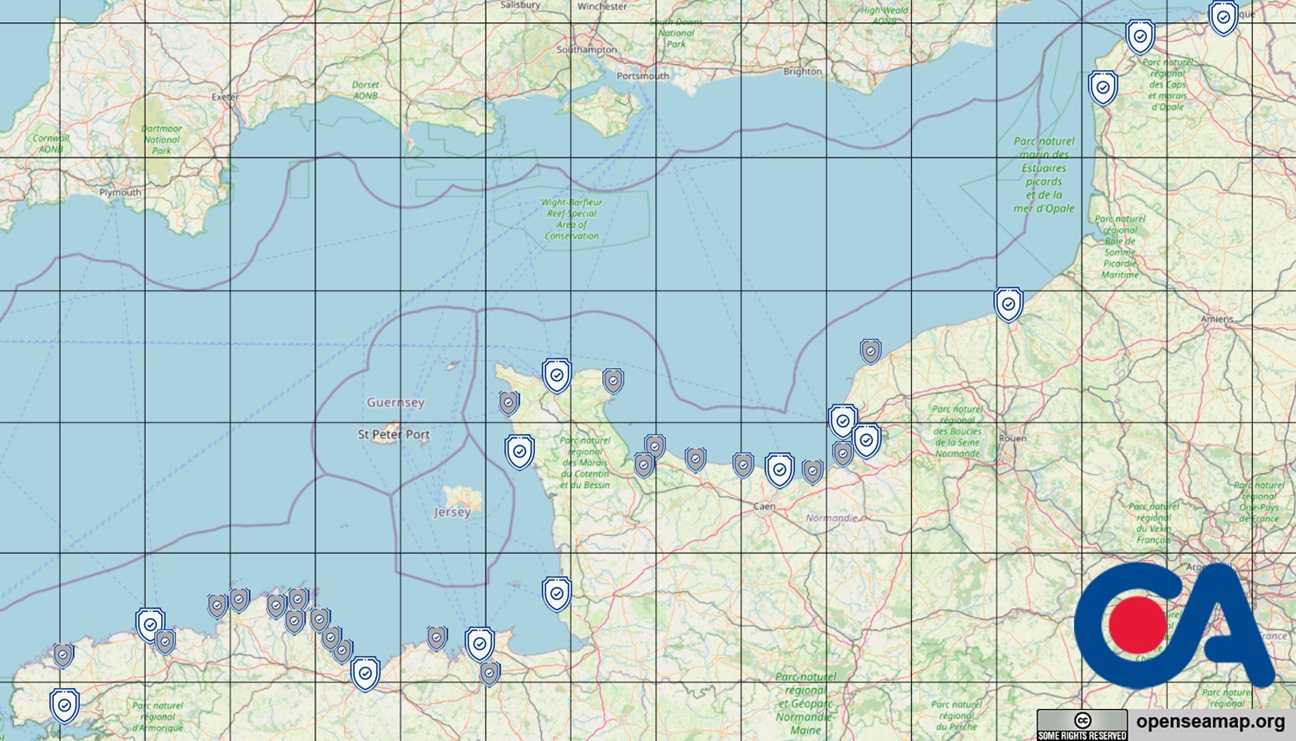
Ports of Entry on the French Channel coast are:
Dunkirk, Calais, Boulogne, Dieppe, Le Havre, Honfleur, Caen-Ouistreham, Cherbourg, Carteret, Granville, St Malo, St Brieuc and Roscoff.
Note that Boulogne has no officials based there but as of May 2026 operates the "protocol" process.
To check in and out of these ports under the full process all crew are required to visit local officials for form completion/submission and passport checking. Some ports of entry require the form to be sent in advance and/or an appointment made. In 2026 a few of these ports also now offer the "protocol" process.
"National Protocol" Ports
As a result of this "protocol" a much larger number of marinas and ports around France were able to offer a service for checking boat crews in and out using emailed forms.
The forms are usually available from the marina websites and should be downloaded, completed and emailed to the email address or addresses provided by the marina either >24 hours before arrival or for shorter passage as departing the previous port. On departure another form must be completed and emailed. With the introduction of EES these forms are no longer returned stamped; the CA recommends you keep copies.
The list of Channel ports which have currently confirmed to the CA that they can process such forms under the "protocol" in June 2026 is as follows:
Calais (PPF and protocol port), Boulogne (a PPF yet without any staff to process entry/exit, but now a 'protocol' port), Fécamp, Deauville-Trouville, Dives sur Mer, Courseulles-Sur-Mer, Port en Bessin, Grandcamp-Maisy, Carentan, St Vaast, Cherbourg (PPF and protocol port), Diélette, Carteret (PPF and 'protocol' port, Plouer-sur-Rance, St Cast (le Guido), Binic, St Quay Portrieux, Paimpol, Lézardrieux, Pontrieux, Tréguier, Perros-Guirec, Trébeurden, Morlaix, L’Aber-Wrac’h.
If you check in via the protocol process (ie your passport is not checked) you must also check out that way; and if you check in using the full process (at a PPF with your passports being checked then you must also check out in the same way. In both cases the port does not need to be the same one. Note also that this "national protocol" process whereby your passport is not stamped may not be seen as legitimate by other EU countries, so if you plan to sail onwards from France to another EU country you should check in first at a port of entry so that an EES entry is recorded. Similarly if you checked in at another country and check out in France then the full process must be undertaken. If crew changes take place then it is also necessary to use the full process so that EES records 'balance'.
In extreme situations such as stress of weather or other force majeure, these requirements may be overridden and any port entered with permission from the harbourmaster.
History
The following provides a summary of past developments on this topic.
Summary of Updates from the Cruising Association published in 2024
French officials have announced a new ‘protocol’ for small boats to enter France from outside of the EU. The new 'protocol' will apply from 1 June 2024 and grants some 53 marinas (which are not Ports of Entry (PPFs) the rights to negotiate with local Officials to handle boats arriving from or departing to outside of the EU/Schengen area.
Summary of Updates from the Cruising Association published in 2023
A number of additional ports on the North Brittany coast have been granted special derogation to process entry and exit papers for pleasure vessels for the summer period and under certain processes and conditions. These are added to those in North Brittany and Normandy granted this derogation in 2022.
Summary of Updates from the Cruising Association published in 2022
A number of ports on the North Brittany and Normandy coast have, over the summer, been granted special derogation to process entry and exit papers for pleasure vessels for the summer period and under certain processes and conditions.
25 March 2025
Disclaimer: Any advice has been prepared voluntarily by the Cruising Association, its members and others and they and it have tried to ensure that the contents are accurate. However, the Cruising Association, its employees, contributors and relevant members shall not be liable for any loss, damage or inconvenience of any kind howsoever arising in connection with the use of and/or reliance on such advice, save to the extent required by applicable law.


