
Departure and Arrival in UK and EU
By CA RATS
Procedures for Reporting Departure and Arrival in UK and EU
The UK, together the United States and many other countries, is considered a Third Country with respect to the EU, and certain procedures must be followed for vessels sailing between the UK and all of the EU and Schengen countries, depending on the nationality of the crew.
The Republic of Ireland, although part of the EU, falls within the Common Travel Area and the rules for travelling to and from there for all nationals are not the same as for the rest of the EU or other Schengen countries. Members can see the Ireland Country Page for further details.
Jump to content
Reporting Departure from and Arrival to the UK
All voyages, irrespective of the nationality of the crew, which start or finish in Great Britain (GB) or Northern Ireland (NI) except those between GB, NI and the Isle of Man must be reported to Border Force. Outbound voyages must be reported before departure from the UK and inbound voyages before departure to the UK. This requirement includes passages to and from the Channel Islands which are not part of the UK. Both Jersey and Guernsey have specific procedures to be followed depending on departure port and nationality of crew. More details can be found here:
Arrival and Departure from Jersey
Arrival and Departure from Guernsey
Reporting is done by submitting a Pleasure Craft Report (sPCR) to the UK Border Force and HMRC. Reporting is best done via the sPCR online facility, although alternative methods are available. Submitting a report online requires that an account be set up but this then allows details of the boat and regular crew to be stored for multiple use. Once set up it is relatively straightforward to create and submit a “Voyage Plan” when required.
Access the online sPCR service here
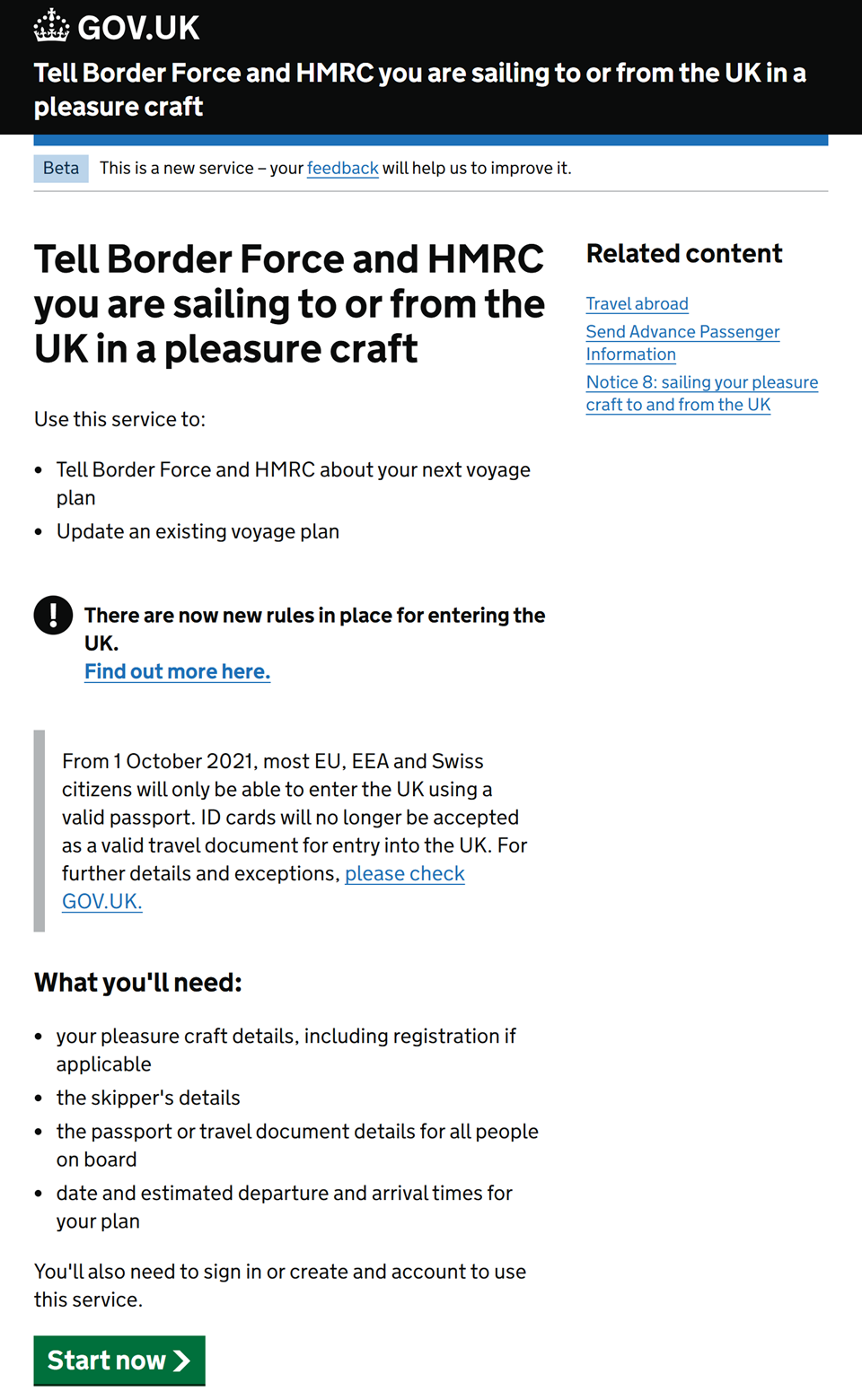
In order to use the sPCR service you need to initially set up a GOV.UK One login, a service started in 2024-25 to provide a single login to all UK Government services. If you have not used the sPCR service before, or have not used it since 2024, you will be redirected to the GOV.UK One setup page. You are advised to use the same email address as previously registered with the sPCR service, to enable you to access your account history and voyage records.
Setting up a GOV.UK One account requires the uploading of identification documents. It is therefore advisable to do this sometime in advance of you needing to submit an sPCR report and where you can guarantee a stable internet connection.
Once you have entered all your registration data you will be sent an Activation Link by email. You must click this link to complete your registration before using the system.
Once registered you can then get on and enter your further data. Much of this will be background data and so can be entered at your leisure.
The online sPCR application is ‘responsive’, i.e. it displays in the form which most suits the screen of the device being used. In the case of a mobile phone, the thing to look out for is the small ‘Menu’ in the top right-hand corner.
If this is the first time you have used the service it will start with ‘Add Information to Your Account’. All stored data may be saved and subsequently accessed and changed (or cancelled or deleted) if necessary.
It will start with boat details and then go on to the skipper’s details including passport details. Finally, you will be given the opportunity to enter details of people you sail with.
Before you start you should get together all your boat’s information:
- Registration Number
- MMSI
- Callsign
Now simply enter the data as requested.
After you have finished entering the data you can save the information. If you have more than one boat you can enter more vessels. This is particularly useful if you are chartering a boat rather than using your own vessel for any particular passage.
Now you can enter the people (crew) data. For this you will need the standard information required for Advance Passenger Information – Full Name, Date and place of birth, Passport (or other travel document), number, issuing state, nationality and passport expiry date. All the information must match exactly that on the crew member’s passport. Now save the person.
You can add more people at this point. Indeed, it is useful to add the details of all those you regularly sail with or expect to sail with, for convenience later when you are making a voyage plan.
Once you have all your prospective crew, including yourself, you are ready to enter a voyage plan.
Here you will be asked for your departure location and time, arrival location and time, to select your crew from those you have entered, and provide a name, address and telephone number for the skipper. You will also be asked if any of the crew are paid hands, whether you have declarable goods on board etc. Make sure to add yourself as Skipper if that is the case – even if the sPCR account is set up in your name it does not assume that you are the Skipper.
If you’re submitting your report online, you must do this within 24 hours and up to 2 hours before departure or arrival. This is the quickest and most efficient way to submit your pleasure craft report. Once submitted you will receive email confirmation of its receipt. Instructions are included in the links below of the steps required if you are unable to report within this timeframe or if your plans change. It is possible to prepare a draft Voyage Plan well in advance of departure, for updating and submission when making final departure arrangements.
If you are submitting a voyage plan in order to travel from the UK to the EU then no further checks are required. However, all crew members need to ensure that their passports are current (less than 10 years old) and valid for at least 3 months from the expected date of departure from the EU. EES processing of all non-EU travellers takes place on entry into the EU, and in 2027 all non-EU visitors to the EU will also be required to have an ETIAS authorisation. As skipper you need to ensure that you and your crew comply, if appropriate, before passage, as you will be refused entry into the EU without the necessary permissions.
Find further information on EES and ETIAS here.
If you are submitting a voyage plan in order to travel to the UK at this stage you may be required to confirm whether all crew members have Universal Permission to Travel (UPT). As skipper it is your responsibility to ensure that all crew members have a right to enter the UK, either by holding a UK passport, an Electronic Travel Authorisation, a standard Visitor Visa or an eVisa. Find information on all these requirements here.
See the latest guidance on GOV.UK:
Whilst the e-C1331 now renamed Pleasure craft on non-UK voyages: leaving or arriving in the UK (pleasure craft report (sPCR) fallback template) email submission remains a valid means of reporting (as does submission by post of the C1331 form) submission via the web app is the preferred option.
Find reporting forms and links to UK Border Force documentation here.
The instructions on the government website are a little confusing and in particular:
For journeys that you must report, you must fly the yellow ‘Q’ flag as soon as you enter UK waters (the 12-mile limit).
Make sure the flag can easily be seen and do not take it down until you’ve finished reporting to customs authorities.
If you do not comply you will be liable to a penalty."
Our underlining. Quite a number of members have reported that they make their submission, receive a confirmatory email and then hear nothing more.
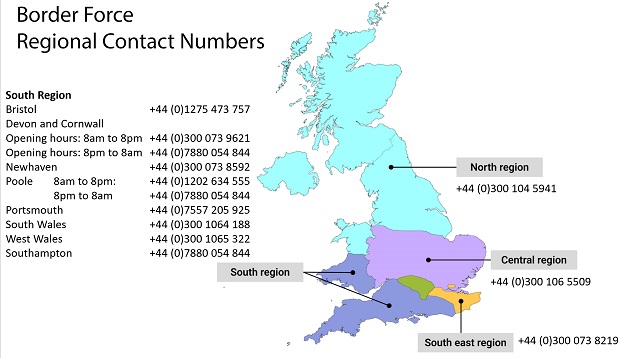
The CA has queried this with Border Force and they have confirmed that you should receive clearance via email, text or phone within the 2-hour arrival window that you have provided. If this does NOT happen then you should telephone the local Border Force operations, covering your arrival location, for clearance to haul down your "Q" flag and to leave the vessel.
See map below for numbers.
National Yachtline
For C1331 Submissions only
Telephone: 0300 123 2012
Opening times: 24 hours a day, 7 days a week
HMRC Notice 8 (replacement) gives details of the documentation and requirements to declare goods purchased outside the UK or changes to the vessel which may be liable for VAT.
Reporting Arrival in and Departure from the EU
General points
All Third Country Nationals (including UK nationals) arriving and departing from the EU are required to:
- Register arrival in and departure from the EU via immigration officials.
- Follow customs clearance procedures.
- Comply with EES processing requirements.
- From a date as yet unconfirmed in 2027 obtain ETIAS clearance for entry into the EU.
For all UK passport holders, be aware of the Schengen requirement that the minimum validity period of passports is 3 months AFTER the intended date of leaving the Schengen area. EU states calculate the expiry date as 10 years from the date of issue, irrespective of the expiry date printed on the passport.
Nationals of countries outside the EU or Schengen countries are not permitted to spend more than 90 days out of 180 days (counted on a rolling basis) in the Schengen area without a visa. Some nationalities must apply for a Schengen visa for any length of stay. To determine whether you or any of your crew require a visa, and if so how to apply, check here.
Currently all passports should be stamped by border authorities on entry to and exit from the Schengen area, although passport stamping is being replaced by the EES system during 2026. During, and maybe after, this period it is advisable to maintain personal records of entry and exit in case of dispute.
Specific details for individual countries are set out on the webpages for each country, giving our best knowledge of the regulations and requirements.
On arrival in the EU by pleasure craft
The yellow Q flag should be flown on entering EU territorial waters (from 12 miles offshore) by vessels of all flags. The exception to this is that, when entering France, the Q flag should ONLY be flown if you have any goods to declare on board.
The situation when entering Ireland from the UK is different because it falls within the Common Travel Area. Members can view the Ireland country page for the latest information
Private yachts should report their arrival to border authorities. Different EU countries have different policies and procedures regarding ports of entry - please check the relevant country page/s for current information. Note that France introduced the “National Protocol of Cooperation” which provides for checking in and out at some ports other than official Ports of Entry.
Arrival in any Schengen Country* effectively "starts the clock" for non-EU nationals in terms of the Schengen 90/180-day rule and if at all possible, passports for yacht crew should be stamped/registered in the EES system (as occurs for entry via Airports/ Ferry terminals).
*Schengen Countries comprise most EU Countries [but NOT Ireland or Cyprus] plus Iceland, Lichtenstein, Norway, Switzerland. It is anticipated that during 2026, following the Gibraltar Agreement between the UK and the EU, travellers to Gibraltar will be treated as though they are in the Schengen Area and their Schengen days will be reduced accordingly, although Gibraltar itself is not joining the Schengen area as such. The Moroccan cities of Ceuta and Melilla are also deemed to be within the Schengen zone, as Spanish enclaves.
Ensure you have good records to show that either the vessel has the status of EU VAT paid or the vessel has arrived from outside the EU and is eligible for Temporary Admission.
On departure from EU (or non-EU Schengen country)
Once a passport has been either stamped or processed through the EES system and arrival has been recorded it is very important to avoid the appearance of an overstay. Failing to check out from the system on departure is likely to have this effect and hence you should ensure that departure from the Schengen Area, if appropriate, is officially recorded by exiting at an external Schengen border and having your passport processed accordingly.
Failure to record departure from Schengen/the EU can cause significant problems for Third Country Nationals. Over-stayers are subject to fines and/or bans from the Schengen Area.
Clear records should also be kept to demonstrate that the vessel has left the EU, e.g. records of customs clearance into the next non-EU destination and proof of arrival such as admission documents or marina invoices.
Suggested list of documents which should be available for inspection on arrival
- Vessel registration certificate
- Certificate of Ownership including VAT status
- Ship's Radio Licence (including reference to portable VHF, RADAR, AIS, EPIRB, PLB, ATIS etc. where fitted)
- Certificate of Competence (Operator's) e.g. ICC and CEVNI for European inland waterways.
- Vessel insurance particularly third party
- Radio operator’s licence
- Ship's Log book
- Record of fuel purchase invoices for the last 12 months and earlier ones if possible
- Passports for all crew and visas if necessary
- Consider also:
- Driving Licence and international driving permit
- Travel and health insurance
- Life raft test certificate (life raft and flares must all be in date)
The Regulatory & Technical Services group (RATS) is an executive committee of the Cruising Association (CA) made up of CA volunteers. RATS gives advice and assistance to CA members and others on a voluntary basis but this is subject to the following Disclaimer and should not be regarded as a substitute for appropriate professional advice.
Disclaimer: Any advice has been prepared voluntarily by the Cruising Association, its members and others and they and it have tried to ensure that the contents are accurate. However, the Cruising Association, its employees, contributors and relevant members shall not be liable for any loss, damage or inconvenience of any kind howsoever arising in connection with the use of and/or reliance on such advice, save to the extent required by applicable law.
See also