Lobster Pot Campaign: What is the Problem?
Poorly marked fishing gear is a hidden hazard at sea
Introduction
Poorly marked fishing gear is a hidden and real safety hazard at sea. Unmarked or inadequately marked pots, creels and fishing gear pose a serious risk to navigation, cause entanglement, damage vessels and can endanger lives.
Unmarked gear is difficult to spot, easy to strike, and capable of causing serious damage, disruption, and danger to those on the water.
Poorly marked gear can lead to:
- Fouled propellers and rudders
- Vessel damage and costly repairs
- Safety risks in poor visibility or heavy weather
To date, the MCA voluntary guidance has not delivered consistent compliance. Fishing gear hazards remain and the majority of responsible fishermen are undermined by a non-compliant minority
The Lobster Pot Campaign is pro-safety – it is not anti-fishing. The issue is not fishing itself, but unsafe marking practices that put all water users at risk.
Jump to content
Tom Cunliffe Explains
In 2018, renowned sailor and author Tom Cunliffe fronted the Lobster Pot Campaign, bringing much-needed attention to the dangers of poorly marked fishing gear. He remains a strong advocate on this issue.
Tom presented a video in 2018 outlining the scale of the problem and has revisited it for 2025, reflecting on how the risks continue to affect those at sea.
Can you spot the fishing buoy
The two videos below demonstrate how challenging it is to spot an unmarked buoy:
Spot the Buoy - unmarked static fishing gear on the Wallet, Essex, UK
Spot the Buoy - unmarked static fishing gear on a Scottish Loch
Quick Facts
- Royal National Lifeboat Institution (RNLI): we believe that since 2017, the RNLI has attended more than 1,000 callouts related to entanglements.
- Royal Yachting Association (RYA): following the introduction of online reporting in 2018, 84 entanglements were recorded in the first year. Since the updated reporting system was relaunched in September 2025, there have been 51 reported entanglements, 6 witnessed incidents, and 117 sightings of poorly marked static fishing gear (as at 14 October 2026).
- HM Coast Guard (HMCG): we believe that HMCG attends approximately 150 incidents each year linked to lobster pots and other static fishing gear.
RYA Reporting Map
View the Royal Yachting Association map showing reported entanglements and sightings of poorly marked static fishing gear:
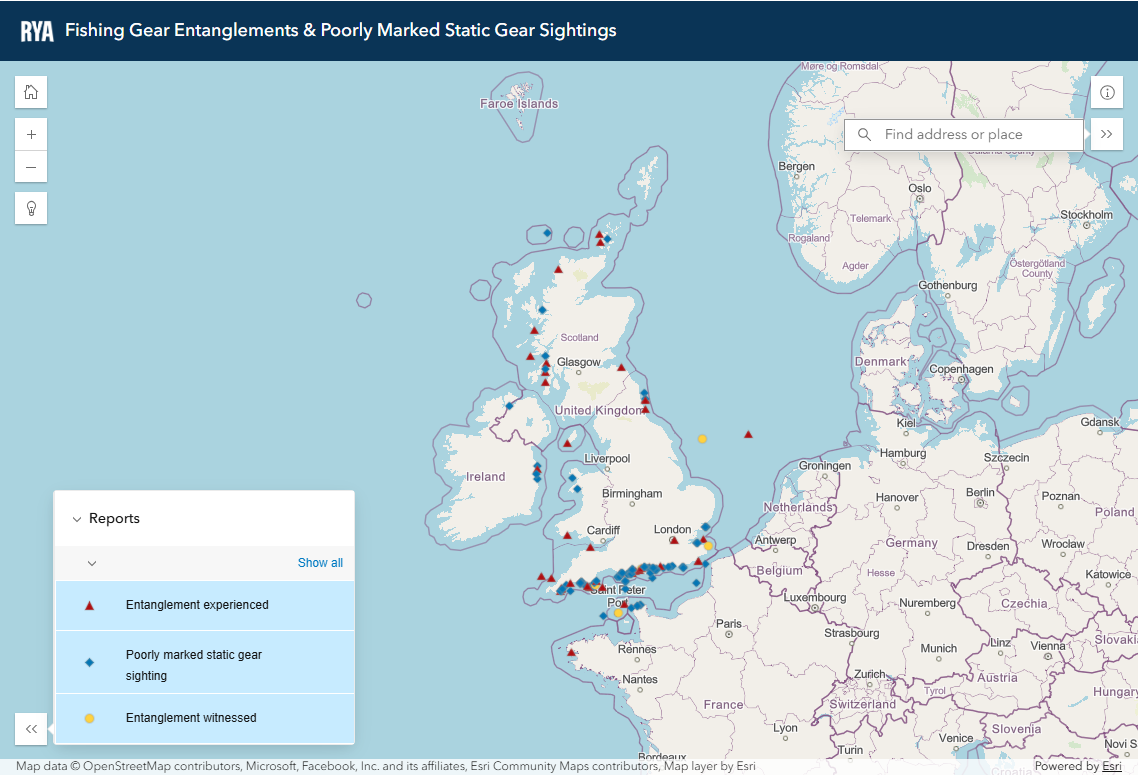
RYA data map as at 16 September 2026
The RYA and the Cruising Association ask sailors to report entanglements and sightings of poorly marked static gear. Reports can be submitted quickly and easily through the RYA Fishing Gear Reporting Form.
What does good marking look like?
The Lobster Pot Campaign supports the use of purpose-made, clearly visible markers for static fishing gear.
Both dhan buoys - typically incorporating a pole and flag - and Norway buoys are both effective options, provided they are appropriately sized, visible and suitable for the conditions in which they are deployed.
The issue is not the use of one particular type of buoy. It is gear that is poorly or inadequately marked, including improvised markers such as plastic containers, small floats or other objects that can be extremely difficult for other vessels to see.
The principle is simple: the marker should be purpose-made and clearly visible to other water users.
Related content
Lobster Pot Campaign Alliance Partners
The Cruising Association is proud to be working with our Alliance Partners who actively help shape and deliver the campaign: The Royal Institute of Navigation (RIN), Practical Boat Owner, Yachting Monthly and the Westerly Owners’ Association (WOA).




Support the Campaign
We hope the Lobster Pot Campaign will be supported by a network of organisations across the marine sector, including boating groups, events, industry, safety organisations, and fishing representatives.
Safer waters depend on all of us. Join the Lobster Pot Campaign and be part of the solution.


